Here is the uncomfortable truth that most buying guides will not tell you straight: window air conditioners are better than portable air conditioners in almost every measurable way. They cool faster, use less electricity, make less noise, and cost less money.
So why does anyone buy a portable AC? Because window units do not fit every window. And in Europe, where tilt-and-turn windows, casement windows, and apartment installation restrictions are the norm, a window AC that cannot be installed is a very expensive paperweight.
This comparison is for people deciding between the two — especially apartment dwellers in Europe and the UK facing another summer of 38-degree heat with no central air.
The Core Difference in One Picture
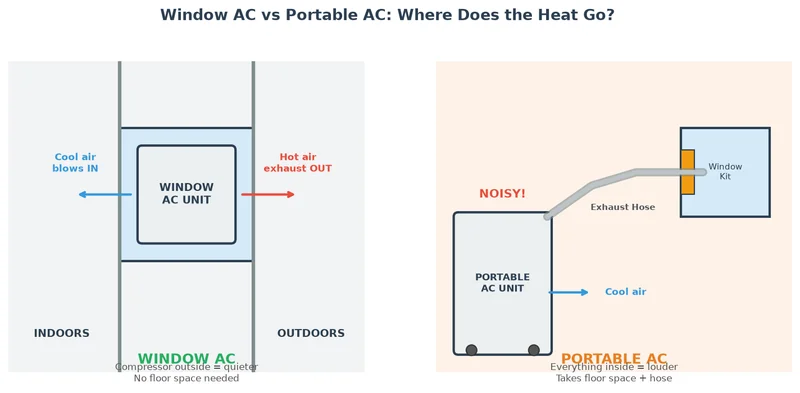
A window AC sits half inside, half outside. The noisy part (compressor, condenser fan) is on the exterior side. It exhausts heat directly outside through the back of the unit. No hose. No negative pressure. Clean, efficient.
A portable AC sits entirely inside your room. Everything — compressor, condenser, fan — is in the box next to your bed. It exhausts heat through a hose routed to a window kit. That hose is 10 to 15 cm in diameter and 1 to 1.5 meters long. The unit also pulls air from your room to cool its condenser, then blows that air out the exhaust hose. That is the critical flaw.
Cooling Efficiency: The Numbers That Matter
Effective BTU Output
This is where portable ACs lose badly, and the reason is not obvious.
A 12,000 BTU window AC delivers roughly 12,000 BTU of cooling to your room. The compressor and condenser are outside, so their waste heat never enters the room.
A 12,000 BTU single-hose portable AC delivers roughly 8,000 to 9,000 BTU of effective cooling. Here is why:
- The unit pulls room air across the condenser to cool it (about 200 to 300 CFM)
- That room air gets heated up and blown out the exhaust hose
- The air removed from the room creates negative pressure
- Hot air from adjacent rooms, the hallway, and cracks around doors gets sucked in to replace it
- You are cooling some of the air you just paid to cool, and fighting infiltration of hot air at the same time
The net result: you lose 25 to 30% of the rated cooling capacity to the single-hose penalty.
Dual-hose portable ACs fix this by having a separate intake hose that pulls outside air for condenser cooling. A 12,000 BTU dual-hose unit delivers close to 12,000 BTU effective. But dual-hose units are harder to find, cost more, and require two holes in your window kit.
| Type | Rated BTU | Effective BTU | Efficiency Loss |
|---|---|---|---|
| Window AC | 12,000 | ~12,000 | ~0% |
| Portable AC (dual-hose) | 12,000 | ~11,000 | ~8% |
| Portable AC (single-hose) | 12,000 | ~8,500 | ~30% |
Energy Efficiency Ratio (EER)
EER = BTU / Watts. Higher is better.
- Window ACs: EER of 10 to 12 is common
- Portable ACs (single-hose): EER of 6 to 8 is typical
- Portable ACs (dual-hose): EER of 8 to 10
A window AC uses roughly 30 to 40% less electricity to deliver the same amount of cooling. Over a summer, that is a real difference on your electric bill.
Noise: The Dealbreaker Nobody Mentifies Enough
This is the biggest quality-of-life difference, and the one that matters most at 2 AM.
Window AC noise: The compressor and condenser fan are outside. Inside, you hear only the indoor blower fan. Typical noise level: 45 to 55 decibels on low, 55 to 60 on high. Comparable to a quiet conversation or background music.
Portable AC noise: The compressor, condenser fan, and blower are all inside the room with you. Typical noise level: 50 to 55 decibels on low, 55 to 65 on high, with an additional compressor hum that cycles on and off. Comparable to a window AC on high, but right next to you instead of across the room.
The decibel numbers do not tell the whole story. The character of the noise matters. A portable AC produces a low-frequency compressor rumble that travels through the floor and walls. It vibrates. It is the kind of sound that you can feel as much as hear, and it is extremely difficult to sleep through if you are a light sleeper.
If the AC is going in a bedroom, this is the single strongest argument for a window unit.
Cost Comparison
Purchase Price
| Capacity | Window AC | Portable AC (single) | Portable AC (dual) |
|---|---|---|---|
| 8,000 BTU | $150 – $250 | $250 – $350 | $350 – $450 |
| 10,000 BTU | $200 – $350 | $300 – $450 | $400 – $550 |
| 12,000 BTU | $250 – $400 | $350 – $550 | $450 – $650 |
| 14,000 BTU | $300 – $500 | $450 – $700 | $550 – $800 |
Window ACs are consistently $100 to $200 cheaper at every capacity level.
Operating Cost
Running a 12,000 BTU unit 8 hours per day for 90 days:
| Type | Watts | Daily Cost | Season Cost |
|---|---|---|---|
| Window AC | ~1,000W | ~$1.20 | ~$108 |
| Portable (dual-hose) | ~1,200W | ~$1.44 | ~$130 |
| Portable (single-hose) | ~1,200W | ~$1.44 | ~$130 |
The portable costs more to run AND delivers less cooling. The effective cost per degree of cooling is roughly 50% higher for a single-hose portable compared to a window unit.
Installation Cost
- Window AC: $0 if you install it yourself (most people do). $50 to $150 if you hire someone.
- Portable AC: $0. Roll it out of the box, attach the window kit, plug it in.
This is where portable ACs win. If you cannot physically install a window unit — landlord will not allow it, window type does not support it, you are not comfortable lifting 30 kg into a window — the portable AC’s zero-installation advantage is worth real money and hassle.
The Window Problem: Why This Decision Is Different in Europe
In the US, most residential windows are double-hung (the kind that slide up and down). Window ACs are designed for these. You open the lower sash, set the AC on the sill, lower the upper sash onto the top of the unit, and seal the gaps with the included foam strips. Ten-minute job.
In Europe, the window situation is completely different:
Tilt-and-Turn Windows (Germany, Austria, Switzerland, much of Central Europe)
These windows swing inward like a door (turn position) or tilt inward at the top (tilt position). There is no sliding sash. A window AC cannot sit on the sill because the window opens inward — the AC would block the window from closing, and there is no way to seal around it.
Workaround: You can buy or make a Plexiglas insert that fits the window opening with a hole for the portable AC exhaust hose. This works with portable ACs, not window ACs.
Casement Windows (UK, France, parts of Southern Europe)
These are windows that crank outward on a hinge. Same problem — no sliding sash for a window AC to sit on.
Workaround: Some companies make casement window AC kits, but they are expensive and not always available for every model.
Sliding Windows (Some modern European apartments)
These work like US windows but oriented horizontally. Window ACs can be installed with a side-mount kit, but the selection of compatible models is smaller.
The Verdict on Windows
| Window Type | Window AC Fits? | Portable AC Fits? |
|---|---|---|
| Double-hung (US standard) | Yes, easily | Yes |
| Tilt-and-turn (Central Europe) | No | Yes, with Plexiglas insert |
| Casement / crank-out (UK, FR) | No (without special kit) | Yes, with casement kit |
| Horizontal slider | Yes, with side kit | Yes |
| Fixed (no opening) | No | No |
If you have tilt-and-turn or casement windows, a portable AC is likely your only option. This single fact overrides every other advantage of window units. A window AC that you cannot install is worthless.
Apartment and Rental Restrictions
Even if your windows could accept a window AC, your building might not:
- Many European apartments prohibit window ACs because they alter the building facade, create noise for neighbors, or pose a falling risk from upper floors
- Some buildings restrict any exterior modification — a window AC visible from the street may violate building rules
- Portable ACs are almost always allowed because nothing is mounted to the building exterior; the window kit is temporary and removable
Check your lease or building rules before buying anything. If window units are banned, the decision is made for you.
Performance in Real-World Tests
CNET’s 2026 air conditioner testing produced concrete numbers. In a controlled test room starting at 90°F (32°C):
Windmill Window AC (8,000 BTU):
- Reached 75°F (24°C) in 30 minutes
- Reached 72°F (22°C) in 50 minutes
- Maintained temperature in 65-72°F range for 63% of test duration
- Noise: 52 dB on low
Dreo Portable AC (14,000 BTU, single-hose):
- Reached 75°F (24°C) in 45 minutes
- Reached 72°F (22°C) in 75 minutes
- Maintained temperature in 68-75°F range for 51% of test duration
- Noise: 57 dB on low
The portable AC has nearly double the rated BTU but cools slower and holds temperature less consistently. That is the single-hose efficiency penalty in action. A 14,000 BTU portable delivering similar real-world results to an 8,000 BTU window unit tells you everything about the efficiency gap.
Which One Should You Buy?
Buy a Window AC if:
- Your windows are double-hung or sliding (the AC fits)
- Your building allows it
- You want the most cooling per euro spent
- It is going in a bedroom (noise matters)
- You plan to use it every summer for years
Buy a Portable AC if:
- You have tilt-and-turn, casement, or awning windows
- Your building prohibits window-mounted units
- You rent and need a zero-installation solution
- You want to move it between rooms
- You need to store it in a closet during winter
Buy a Dual-Hose Portable AC if:
- You need a portable (see above) AND
- Your room is larger than 20 square meters
- You care about electricity cost
- You can find one — they are less common but brands like DeLonghi, Whynter, and Black+Decker make them
Quick Decision Flowchart
Can you physically install a window AC in your window?
- No → Portable AC (your only real option)
- Yes → continue
Does your building allow window ACs?
- No → Portable AC
- Yes → continue
Is noise a critical factor (bedroom, light sleeper)?
- Yes → Window AC (significantly quieter)
- No → continue
Do you need to move it between rooms?
- Yes → Portable AC
- No → Window AC (better in every other way)
One Final Note on Sizing
Whether you choose window or portable, get the right size. An undersized unit runs constantly and never reaches your set temperature. An oversized unit short-cycles (turns on and off frequently), which wastes energy and dehumidifies poorly.
For European apartments with typical 2.5 to 3 meter ceilings:
| Room Size | Window AC | Portable AC (single) | Portable AC (dual) |
|---|---|---|---|
| 15 m² (small bedroom) | 7,000 BTU | 9,000 BTU | 8,000 BTU |
| 20 m² (large bedroom) | 9,000 BTU | 12,000 BTU | 10,000 BTU |
| 30 m² (living room) | 12,000 BTU | 14,000 BTU | 12,000 BTU |
| 40 m² (open plan) | 14,000 BTU | 16,000-18,000 BTU | 14,000 BTU |
Portable ACs need higher BTU ratings to compensate for the efficiency loss. A 12,000 BTU portable (single-hose) cools about as well as a 9,000 BTU window unit. Size accordingly.
Related: How to Keep Your Apartment Cool Without AC | Before You Buy a Portable AC | Portable AC vs Evaporative Cooler