It is 38 degrees outside. Your apartment is 34. The walls — thick stone or concrete that your landlord proudly calls “solid construction” — spent the last ten hours absorbing heat like a battery. Now it is evening, the sun is down, and the apartment is somehow hotter than it was at noon. The walls are giving all that heat back.
If you have air conditioning, you are not reading this. You are reading this because you do not have AC — like roughly 80% of apartment dwellers in Germany, the UK, France, and most of northern and central Europe. The AC penetration rate in Germany is 6%. In the UK it is 5%. You are not alone.
Here is what works, what does not, and what order to do it in. I am ranking these from fastest cooldown to longest-term strategy, because when your bedroom is 34 degrees at midnight, you need the fast stuff first.
First: Stop More Heat From Coming In (Do This Right Now)
Every minute you spend on this saves you an hour of suffering later. Heat enters apartments through windows, and windows are responsible for 40 to 70% of summer heat gain. Deal with the windows first.
Close the shutters. All of them. On the sunny side.
If you live in southern Europe, you probably have exterior roller shutters (persianas in Spain, rollladen in Germany, avvoltabili in Italy). Close them completely on any window that gets direct sun. Exterior shutters block heat before it hits the glass — that is dramatically more effective than anything you do inside.
If you do not have exterior shutters, close interior blinds or curtains on sun-facing windows. It is less effective but still worth doing. Blackout curtains are better than light-colored ones for blocking heat (counterintuitive but true — they block more infrared radiation).
The critical rule: Close sun-facing windows and coverings before 9 AM. Do not wait until the room feels hot. By then the heat is already inside.
Reflective window film — cheap and surprisingly effective
A roll of reflective window film costs about 10 to 15 euros and takes 20 minutes to apply. It reflects 70 to 90% of solar heat while still letting some light through. It is not pretty — your windows will look mirrored from the outside — but it cuts heat gain through glass by roughly half.
This is the single best under-20-euro investment for a hot apartment. Apply it to south- and west-facing windows only. You can remove it in autumn without damaging the glass if you buy the static-cling kind (not adhesive).
Keep interior doors closed to unused rooms
If you have a hallway, a bathroom, a storage room — close those doors. You are not trying to cool the entire apartment. You are trying to cool the room you are sitting in. Smaller volume = faster cooldown.
Second: Get the Hot Air Out (The Two-Fan Method)
If the outside temperature is lower than inside — which it usually is after sunset — open windows and create airflow. But not just any airflow.
A single fan pointing at your face feels nice but does not cool the room. It just moves hot air around. To actually lower the room temperature, you need to push hot air out and pull cool air in.
The setup:
- Open a window on the coolest side of the building (usually the shaded side, or the side facing a courtyard rather than a street)
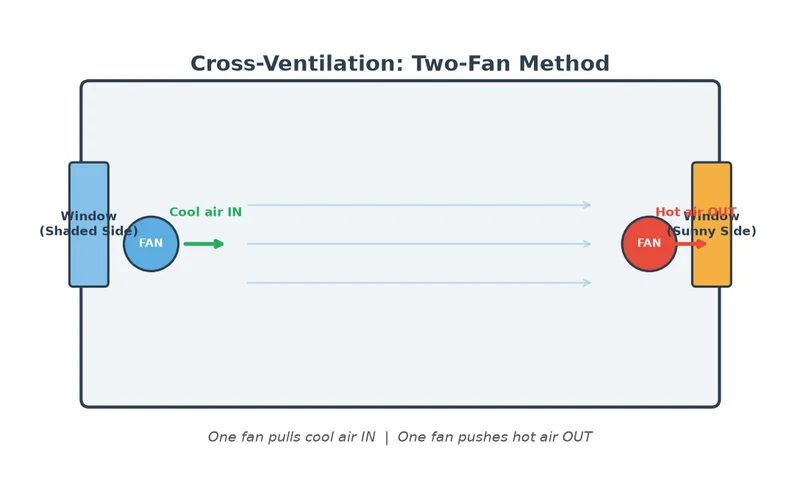
- Place a fan in that window blowing inward — pulling cool outside air into the room
- Open a window on the opposite side of the apartment
- Place a second fan in that window blowing outward — pushing hot inside air out
This creates a through-draft that exchanges the entire room’s air volume every few minutes. In a typical 25-square-meter room with two 40cm box fans, you can drop the temperature from 34 to match the outside air (often 22 to 24 at night) in about 10 to 15 minutes.
No second fan? Open two windows on opposite sides and place one fan blowing outward. The negative pressure will pull air in through the other window. It is slower but it works.
What about tilt-and-turn windows? These are standard across Europe. The tilt position (small opening at top) does not create enough airflow for effective cooling. You need to swing the window fully open for the two-fan method. If safety is a concern (ground floor, children), open only while you are awake and in the room.
Third: Night Flushing — The Secret Weapon for Thick Walls
This is the technique that matters most in European apartments with heavy walls, and almost nobody talks about it.
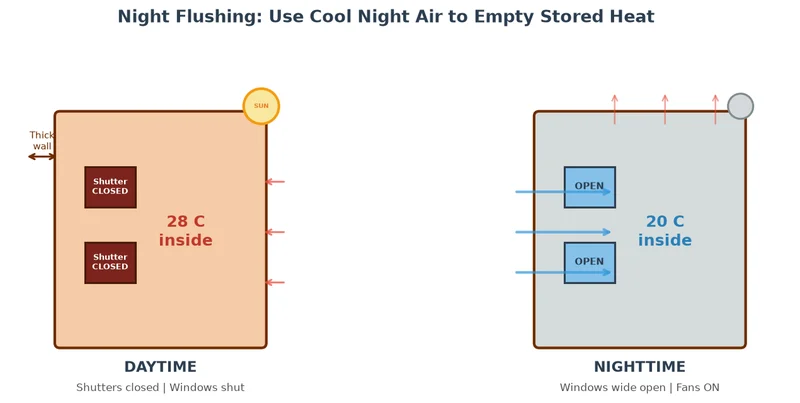
Stone, brick, and concrete have high thermal mass. They absorb heat slowly during the day and release it slowly at night. This is great in winter — free heating. In summer it is a curse. Your walls are a thermal battery that charges all day and discharges all night, keeping the room warm even when the outside air has cooled.
Night flushing means opening windows wide and running fans at full speed during the coolest hours (typically 2 AM to 7 AM) to push cool air past the walls and floors, literally pulling stored heat out of the building materials.
How to do it:
- Before bed, open every window in the apartment wide
- Set fans to blow cool air in and hot air out (the two-fan method)
- If you have shutters, open them at night to let the walls radiate heat to the outside
- Leave this running all night if you can sleep with the noise and it is safe
- First thing in the morning — around 7 or 8 AM — close everything. Shutters down, windows closed, curtains drawn
The goal is to start the day with walls that are as cool as possible. If you flush effectively, your apartment might stay below 28 degrees all day even when it is 38 outside — because the walls are starting from a lower temperature and take longer to heat up.
This works best in climates with a big day-night temperature swing. In Madrid, daytime 40 and nighttime 20 is common — perfect for night flushing. In humid coastal cities where nights stay at 28, it helps less because there is less cool air to work with.
Fourth: Evaporative Cooling (When Air Is Dry)
If you live in a dry climate — interior Spain, southern France away from the coast, most of Italy inland — evaporation is your friend. Water absorbs a huge amount of heat when it evaporates. You can use this.
The wet towel method
Hang a damp (not dripping) towel or sheet in front of a fan or an open window. As air passes through the wet fabric, water evaporates and cools the air. It is the same principle as a swamp cooler. You can drop air temperature by 3 to 5 degrees this way.
Re-wet the towel every couple of hours. Use the thinnest fabric you have — it evaporates faster.
The bowl of ice in front of a fan
This one gets dismissed as a myth, but it actually works — just not the way most people do it. A single bowl of ice in the corner does nothing. But a large bowl or bucket of ice placed directly in front of a box fan, with the fan blowing over the ice toward you, will cool the air in your immediate vicinity by a noticeable amount for 30 to 60 minutes.
It is not a room-cooling solution. It is a “I am dying at my desk and need 20 minutes of relief” solution. Freeze water in large containers (not ice cube trays — too small) overnight and set them up during the hottest part of the afternoon.
Does this work in humid climates?
Not well. If the humidity is above 60%, the air is already saturated with water vapor and cannot absorb much more. Evaporative methods barely help in London, Amsterdam, or coastal Portugal. They work well in Madrid, Seville, or inland Greece.
Fifth: Cool Yourself, Not Just the Room
When the room is 33 degrees and you have done everything above, the room is still 33 degrees. Some apartments will not cool below that no matter what you do. Time to focus on cooling your body.
- Wet a bandana or cloth, put it in the freezer for 15 minutes, then wrap it around your neck. The neck has major blood vessels close to the skin. Cooling your neck cools your entire body faster than any other single spot.
- Run cold water over your wrists for 30 seconds. Same principle — high blood flow, close to the surface.
- Sleep on damp sheets. It sounds miserable but it works. Lightly dampen a top sheet, wring it out so it is barely wet, and sleep under it with a fan blowing on you. The evaporation keeps you cool. People in hot climates have done this for centuries.
- Take a lukewarm shower before bed, not a cold one. A cold shower triggers your body to conserve heat. A lukewarm shower gradually lowers your core temperature without the rebound effect.
- Sleep low. Hot air rises. If you have a floor you can sleep on, do it. The temperature difference between head height and floor level can be 2 to 4 degrees in a hot room.
- Hydrate. You are sweating. Replace the water. If you feel dizzy or get a headache, that is early heat exhaustion — drink water with a pinch of salt, or an electrolyte drink.
Sixth: Long-Term — Things to Buy or Install
If heatwaves are becoming a yearly event (they are), consider these investments:
| Solution | Cost | Effectiveness | Best For |
|---|---|---|---|
| Reflective window film | 10-15 EUR | Moderate | Any sun-facing window |
| Blackout curtains | 30-60 EUR | Moderate | Bedrooms |
| Exterior shade cloth/awning | 50-150 EUR | High | South-facing balcony/window |
| Box fans (2x) | 30-50 EUR | High | Cross-ventilation |
| Portable evaporative cooler | 100-200 EUR | High (dry climate only) | Inland apartments |
| Portable air conditioner | 300-600 EUR | High | Any apartment (see our comparison) |
The hierarchy of effectiveness:
- Block heat at the exterior (shutters, awnings, shade cloth) — stops heat before it enters
- Block heat at the window (film, curtains) — stops heat at the glass
- Remove heat (ventilation, night flushing) — gets rid of heat that already entered
- Add coolth (evaporative cooling, AC) — actively cools the air
Every euro spent on blocking heat saves three euros on cooling. Prevention beats removal.
What Does NOT Work (Stop Wasting Time On These)
- A single fan in a closed room. It circulates hot air. It does not cool anything.
- Ice cubes in a bowl in the corner. Too little ice, too far from the airflow.
- Opening the fridge to cool the kitchen. The fridge’s compressor generates more heat than the open door removes. You are warming the room.
- Wet towels on the floor. No airflow = no evaporation = no cooling = just a wet floor.
- Closing vents or doors to “trap cool air.” There is no cool air to trap. You are just reducing airflow.
The Quick Reference Card
| Time of Day | Action |
|---|---|
| 7 AM | Close all windows and shutters on sun-facing side |
| 9 AM | Close remaining windows. Curtains drawn. Fans off. |
| 12-5 PM | Hottest hours. Stay in the coolest room. Use body-cooling techniques. |
| 6 PM | Check outside temp vs inside. If cooler outside, start opening windows. |
| 8 PM | Open everything. Start two-fan ventilation. |
| 2-7 AM | Night flushing: fans on high, windows wide open. |
| 7 AM | Close everything again. Repeat. |
The cycle is: seal up during the day, ventilate aggressively at night. Most people do the opposite — open windows during the day because it “feels stuffy,” which lets hot air in, then close up at night because of noise or bugs, trapping the heat. Flip that pattern and your apartment stays dramatically cooler.
Related: 3 Ways to Cool a Room Without AC | Window AC vs Portable AC Comparison | Before You Buy a Portable AC