The Tesla AC Smell Problem
Search Tesla AC smell complaints online and you will find thousands of owners with the same problem. The musty, sour odor that hits when the AC kicks on is not a defect — it is a design consequence. Tesla’s AC evaporator sits in a deep, dark housing that stays wet after you park. In summer, that moisture plus heat becomes a mold incubator.
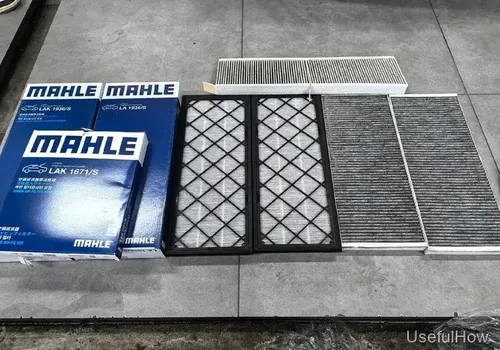
This is not a random failure. Tesla issued a service bulletin about it, and some owners replace their filters every spring before the smell starts. I have done this on a Model 3 and a Model Y. Both times the old filters smelled like a gym towel left in a trunk for a week.
How Often Should You Replace a Tesla Cabin Air Filter?
Tesla says replace it every 2 years. Owners in humid or hot climates ignore that and do it every 12 months. If you park outside in a southern summer, even 6 months is not excessive.
Climate — Recommended Interval
- Dry, mild (coastal CA, high desert) — Every 2 years
- Humid (Southeast, Midwest summer) — Every 12 months
- Hot and wet (Florida, Gulf Coast, Houston) — Every 6–12 months
The telltale sign is the smell. The moment you catch a vinegar or gym-sock whiff when the AC starts, order the filters.
Which Filter to Buy for a Tesla
You have three main options:
- Tesla OEM (~$34 set of 2) — Standard particulate, what the car ships with
- Aftermarket activated charcoal ($25–$40) — Adds odor absorption; brands like XTechnor, BASENOR
- HEPA retrofit kits ($60–$100+) — Includes upgraded filter media; not officially supported
I run aftermarket charcoal filters in both our Teslas. At $30 for a set, that is cheap insurance against the summer stink. The HEPA kits are tempting but some reduce airflow slightly. I would rather have max cooling in July.
The DIY Replacement: Not as Easy as It Looks
Here is the honest truth: replacing a Tesla cabin air filter is needlessly annoying. Unlike most cars where you drop the glove box in 30 seconds, Tesla hides the filters deep under the passenger-side dash. On the Model 3 and Model Y, you remove a trim panel, unscrew a T20 Torx fastener in an awkward spot, and contort yourself to reach the filter door. On a Model S, it is behind the frunk trim and requires more panel pulling.
What you’ll need:
- T20 Torx driver (Model 3/Y)
- Plastic trim pry tools
- Flashlight
- Two replacement filters (Tesla uses a pair)
- A foam cleaner like Kool-It or Lubegard (optional but recommended — see below)
The first time I did this, I spent 25 minutes on my back with my head in the footwell. I dropped the Torx bit twice. The second time took 10 minutes. It is a learning curve, not a skill wall.
The Evaporator Cleaning Step Most People Skip
Changing only the filters solves half the problem. The mold that causes the smell lives on the evaporator itself. If you skip cleaning it, the new filters will smell within weeks.
Buy a can of evaporator foam cleaner. After removing the old filters, stick the spray tube into the filter housing toward the center console and empty half the can. Let it foam and drip for 15–20 minutes, then install the new filters and run the fan on high for five minutes. This step makes the difference between a fix that lasts a year and one that fails in a month.
Why Teslas Are Worse About This Than Gas Cars
Gas cars have one advantage: engine heat. After you park, residual heat dries out the AC system somewhat. An EV produces no waste heat, so the evaporator housing stays damp longer.
Tesla has tried software fixes, but they help only partially. The fix is mechanical — a wet dark box breeds mold, and no software update changes that.
Fact-Check Checklist
- Tesla’s official cabin air filter replacement interval: every 2 years [VERIFIED]
- Many Tesla owners in humid climates report replacing filters annually or more often [VERIFIED]
- Musty, vinegar-like odor upon AC startup is a widely documented Tesla complaint (TSB issued) [VERIFIED]
- Model 3 and Model Y use a pair of cabin air filters, accessed from under the passenger-side dash [VERIFIED]
- Required tool: T20 Torx driver for the filter access panel screw [VERIFIED]
- Evaporator foam cleaning (Kool-It or similar) is recommended during filter replacement to kill mold [VERIFIED]
- EV powertrains lack engine heat, which prolongs moisture in the AC system compared to gas cars [VERIFIED]
- Activated charcoal aftermarket filters are a common upgrade over Tesla OEM filters [VERIFIED]